How Much Protein Do You Actually Need? (Spoiler: It’s Less Than You Think)
Instagram fitness influencers want you to eat your body weight in grams of protein every day. We cut through the bro-science to explain why 0.7g per lb is plenty for most regular people, and how your goal (Bulking vs. Cutting) changes the math.
Read Time: 4 Mins
If you spend five minutes on Fitness TikTok, you will be convinced that unless you are consuming 200g of protein a day, your muscles will instantly wither away and fall off your skeleton.
You have probably been told the "Golden Rule": Eat 1 gram of protein per pound of body weight.
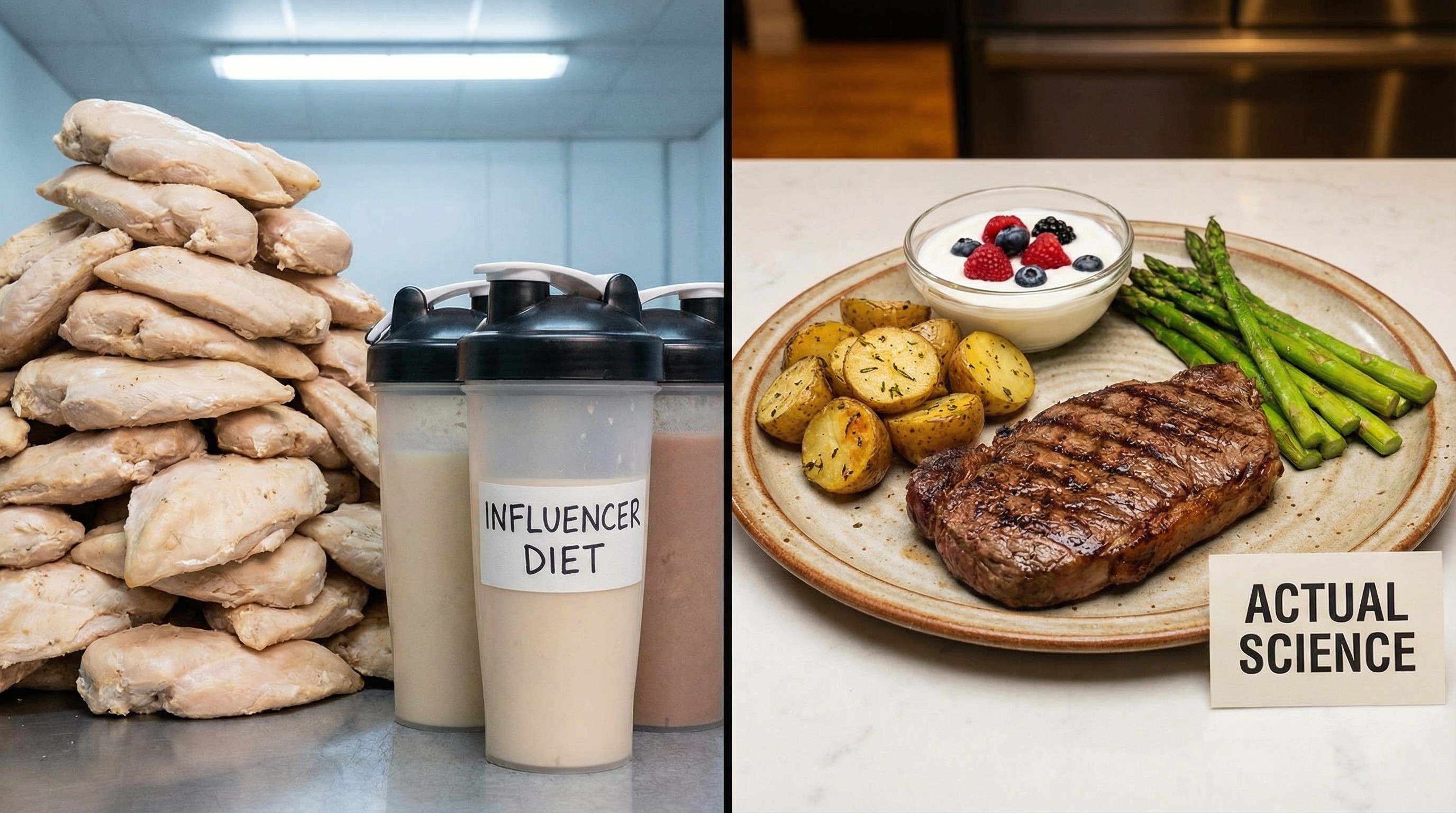
So, if you weigh 180 lbs (80kg), you are trying to smash 180g+ of protein every single day. That is three chicken breasts, a protein shake, four eggs, and a tub of Greek yogurt. It is expensive. It is difficult. And frankly, it is exhausting.
Here is the good news: You almost certainly do not need that much.
For the vast majority of regular people (who aren't injecting performance-enhancing drugs), the "Golden Rule" is total overkill. Here is the actual science.
The Origin of the "1g per lb" Myth
Where did this number come from?
Rounding Up: The scientific metric is usually 2.2g per kilogram. Since 1kg = 2.2lbs, "Gym Bros" simplified the maths to 1g per lb. It’s catchy, but it’s high.
Supplement Sales: If a magazine tells you to eat 250g of protein, you physically cannot do it with food alone. So, you have to buy protein powder. It’s a great marketing tactic.
Elite Bodybuilders: Pros on steroids have elevated protein synthesis. They can use more protein. You, Dave from Accounts, probably cannot.
The Real Number: 0.7g per Pound
Multiple scientific meta-analyses (studies of studies) have looked at protein intake for natural lifters.
The consensus? The benefits of protein for muscle building plateau at around 0.7g to 0.8g per pound of body weight (or roughly 1.6g per kg).
What does that look like in real life?
If you are a 180 lb (81 kg) male:
The "Bro" Myth: 180g - 200g protein/day.
The Science: 126g - 144g protein/day.
That is a difference of 50g of protein. That is equivalent to two entire scoops of whey or a whole chicken breast that you don't have to force-feed yourself.
Adjusting for Your Goal (Cut vs. Bulk vs. Maintain)
While 0.7g/lb is the scientific "sweet spot," your specific goal does change the strategy slightly. Here is exactly how to adjust:
1. Fat Loss (The Cut)
Target: Higher (0.8g - 1g per lb)
Why: When you are in a calorie deficit, your body is looking for energy. If you aren't careful, it might burn muscle tissue for fuel. Eating higher protein protects your muscles (muscle sparing).
The Bonus: Protein is the most filling macronutrient. Eating more of it keeps you full when your calories are low, stopping you from raiding the biscuit tin at 9 PM.
2. Muscle Gain (The Bulk)
Target: Moderate (0.7g - 0.8g per lb)
Why: This surprises people. You actually don't need extra protein to bulk. Why? Because you are eating excess calories (carbs and fats). Carbs are "protein sparing," meaning your body has plenty of energy and doesn't need to touch your protein stores.
The Strategy: Save your calories for Carbs (pasta, rice, potatoes) to fuel heavy lifting, rather than stuffing yourself with unnecessary extra chicken.
3. Maintenance (The Lifestyle)
Target: Standard (0.7g per lb)
Why: You aren't stressing your body with a deficit, and you aren't force-feeding it for growth. This is the "livable" zone where you can relax, enjoy your food, and just hit a sensible target.
Why "Good Enough" is Better than "Perfect"
Aiming for 200g of protein is why most people quit tracking. It feels like a chore. You spend your life chugging lukewarm shakes and eating dry tuna.
Aiming for 130g? That is manageable.
Breakfast: Eggs on toast.
Lunch: A decent sandwich (check our Meal Deal guide).
Dinner: Chicken/Beef/Tofu with pasta.
Snack: A yogurt.
Boom. You hit the target. You lived your life. You enjoyed your food.
The Bottom Line
Stop stressing about hitting a perfect, sky-high number.
Cutting? Bump it up slightly to keep full and save muscle.
Bulking? Keep it moderate and enjoy the extra carbs.
Living? Hit 0.7g per lb and enjoy your life.
Not sure what 140g of protein actually looks like? Most people underestimate the protein in pasta and bread, and overestimate the protein in nuts.
Download MyMacroGo. Track your intake for a week and see where you actually land. It’s probably better than you think.
Read Time: 4 Mins
If you spend five minutes on Fitness TikTok, you will be convinced that unless you are consuming 200g of protein a day, your muscles will instantly wither away and fall off your skeleton.
You have probably been told the "Golden Rule": Eat 1 gram of protein per pound of body weight.
So, if you weigh 180 lbs (80kg), you are trying to smash 180g+ of protein every single day. That is three chicken breasts, a protein shake, four eggs, and a tub of Greek yogurt. It is expensive. It is difficult. And frankly, it is exhausting.
Here is the good news: You almost certainly do not need that much.
For the vast majority of regular people (who aren't injecting performance-enhancing drugs), the "Golden Rule" is total overkill. Here is the actual science.
The Origin of the "1g per lb" Myth
Where did this number come from?
Rounding Up: The scientific metric is usually 2.2g per kilogram. Since 1kg = 2.2lbs, "Gym Bros" simplified the maths to 1g per lb. It’s catchy, but it’s high.
Supplement Sales: If a magazine tells you to eat 250g of protein, you physically cannot do it with food alone. So, you have to buy protein powder. It’s a great marketing tactic.
Elite Bodybuilders: Pros on steroids have elevated protein synthesis. They can use more protein. You, Dave from Accounts, probably cannot.
The Real Number: 0.7g per Pound
Multiple scientific meta-analyses (studies of studies) have looked at protein intake for natural lifters.
The consensus? The benefits of protein for muscle building plateau at around 0.7g to 0.8g per pound of body weight (or roughly 1.6g per kg).
What does that look like in real life?
If you are a 180 lb (81 kg) male:
The "Bro" Myth: 180g - 200g protein/day.
The Science: 126g - 144g protein/day.
That is a difference of 50g of protein. That is equivalent to two entire scoops of whey or a whole chicken breast that you don't have to force-feed yourself.
Adjusting for Your Goal (Cut vs. Bulk vs. Maintain)
While 0.7g/lb is the scientific "sweet spot," your specific goal does change the strategy slightly. Here is exactly how to adjust:
1. Fat Loss (The Cut)
Target: Higher (0.8g - 1g per lb)
Why: When you are in a calorie deficit, your body is looking for energy. If you aren't careful, it might burn muscle tissue for fuel. Eating higher protein protects your muscles (muscle sparing).
The Bonus: Protein is the most filling macronutrient. Eating more of it keeps you full when your calories are low, stopping you from raiding the biscuit tin at 9 PM.
2. Muscle Gain (The Bulk)
Target: Moderate (0.7g - 0.8g per lb)
Why: This surprises people. You actually don't need extra protein to bulk. Why? Because you are eating excess calories (carbs and fats). Carbs are "protein sparing," meaning your body has plenty of energy and doesn't need to touch your protein stores.
The Strategy: Save your calories for Carbs (pasta, rice, potatoes) to fuel heavy lifting, rather than stuffing yourself with unnecessary extra chicken.
3. Maintenance (The Lifestyle)
Target: Standard (0.7g per lb)
Why: You aren't stressing your body with a deficit, and you aren't force-feeding it for growth. This is the "livable" zone where you can relax, enjoy your food, and just hit a sensible target.
Why "Good Enough" is Better than "Perfect"
Aiming for 200g of protein is why most people quit tracking. It feels like a chore. You spend your life chugging lukewarm shakes and eating dry tuna.
Aiming for 130g? That is manageable.
Breakfast: Eggs on toast.
Lunch: A decent sandwich (check our Meal Deal guide).
Dinner: Chicken/Beef/Tofu with pasta.
Snack: A yogurt.
Boom. You hit the target. You lived your life. You enjoyed your food.
The Bottom Line
Stop stressing about hitting a perfect, sky-high number.
Cutting? Bump it up slightly to keep full and save muscle.
Bulking? Keep it moderate and enjoy the extra carbs.
Living? Hit 0.7g per lb and enjoy your life.
Not sure what 140g of protein actually looks like? Most people underestimate the protein in pasta and bread, and overestimate the protein in nuts.
Download MyMacroGo. Track your intake for a week and see where you actually land. It’s probably better than you think.