Why 'Starvation Mode' Isn't Ruining Your Metabolism
Missed lunch? Don't panic. We bust the myth that skipping a meal puts you into "starvation mode" and explain why your metabolism isn't as fragile as TikTok tells you it is.
Read Time: 3 Mins
It’s 2:00 PM. You missed lunch because a meeting ran over. Your stomach growls. Then, the panic sets in.
You remember reading somewhere, probably on Instagram, that if you don't eat every three hours, your body enters "Starvation Mode." You are terrified that because you skipped a sandwich, your body is now panicking, shutting down your metabolism, and clinging to every gram of fat on your body for survival.
This is one of the biggest myths in the fitness industry.
Your metabolism is not a fragile flower. It is a survival engine. Here is why skipping a meal won't ruin your progress, and why "Starvation Mode" is mostly nonsense.
The "Stoke the Fire" Myth
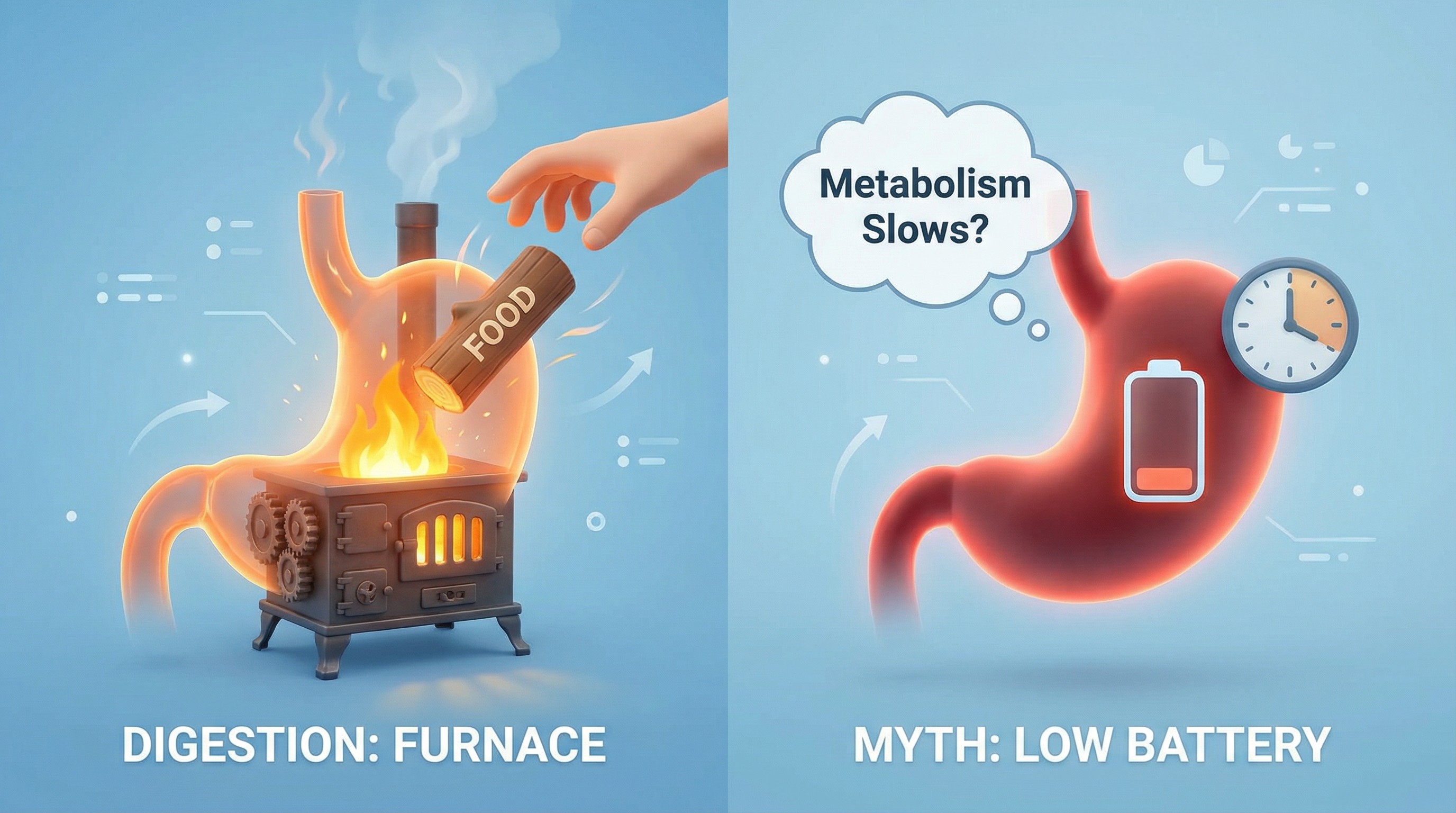
For years, bodybuilders told us we had to eat 6 small meals a day to "stoke the metabolic fire." The logic was that digestion burns calories (which is true), so eating often keeps the fire burning.
The Reality: The "Thermic Effect of Food" (calories burned digesting) is based on the total amount of food you eat, not how many times you eat it.
Scenario A: You eat 2,000 calories across 6 small meals.
Scenario B: You eat 2,000 calories across 2 big meals.
Result: You burn roughly the same amount of calories digesting both. Frequency is irrelevant for fat loss.
Real Starvation vs. Missing a Greggs
"Starvation Mode" (scientifically called Adaptive Thermogenesis) is a real biological process. But it doesn't happen because you missed breakfast.
It happens when you are actually starving. We are talking about weeks of severe calorie restriction like being stranded on a desert island.
In that extreme scenario, yes, your body eventually slows down non-essential functions (like hair growth and fidgeting) to save energy. But it does not happen because you went 6 hours without a snack.
If you skip lunch, your body doesn't think it's dying. It just switches to burning stored energy (fat/glycogen). That is literally what body fat is there for—it is a packed lunch you wear on your waist.
The Rebrand: It's Just "Intermittent Fasting"
Think about it this way:
If you skip breakfast because you're busy, you panic about "Starvation Mode."
If a tech CEO skips breakfast on purpose, they call it "Intermittent Fasting" and say it boosts their focus.
Physiologically, it is the exact same thing. Your body is just going a bit longer without food. It is not damaged; it is just waiting.
The Real Danger of Skipping Meals
While your metabolism is fine, there is a danger to skipping meals: The Rebound Binge.
The problem isn't that your metabolism slows down; it's that by 7:00 PM, you are so ravenous that you lose all self-control.
You skip lunch (save 600 calories).
You feel virtuous.
You get home at 6:00 PM starving.
You eat the entire contents of the fridge while waiting for dinner to cook (consume 1,200 calories).
Result: You are in a calorie surplus. Not because your metabolism broke, but because you got too hungry and overate.
The Bottom Line
Stop stressing about the clock.
Meal Timing: Doesn't matter for fat loss.
Total Calories: Matters everything.
If you miss a meal, don't force-feed yourself later to "catch up." Just eat a normal dinner. Your metabolism will be just fine.
Worried about hitting your daily targets after a weird day of eating? Check your totals in seconds.
Download MyMacroGo. See your daily protein and calorie totals at a glance, no matter when you ate them.
Read Time: 3 Mins
It’s 2:00 PM. You missed lunch because a meeting ran over. Your stomach growls. Then, the panic sets in.
You remember reading somewhere, probably on Instagram, that if you don't eat every three hours, your body enters "Starvation Mode." You are terrified that because you skipped a sandwich, your body is now panicking, shutting down your metabolism, and clinging to every gram of fat on your body for survival.
This is one of the biggest myths in the fitness industry.
Your metabolism is not a fragile flower. It is a survival engine. Here is why skipping a meal won't ruin your progress, and why "Starvation Mode" is mostly nonsense.
The "Stoke the Fire" Myth
For years, bodybuilders told us we had to eat 6 small meals a day to "stoke the metabolic fire." The logic was that digestion burns calories (which is true), so eating often keeps the fire burning.
The Reality: The "Thermic Effect of Food" (calories burned digesting) is based on the total amount of food you eat, not how many times you eat it.
Scenario A: You eat 2,000 calories across 6 small meals.
Scenario B: You eat 2,000 calories across 2 big meals.
Result: You burn roughly the same amount of calories digesting both. Frequency is irrelevant for fat loss.
Real Starvation vs. Missing a Greggs
"Starvation Mode" (scientifically called Adaptive Thermogenesis) is a real biological process. But it doesn't happen because you missed breakfast.
It happens when you are actually starving. We are talking about weeks of severe calorie restriction like being stranded on a desert island.
In that extreme scenario, yes, your body eventually slows down non-essential functions (like hair growth and fidgeting) to save energy. But it does not happen because you went 6 hours without a snack.
If you skip lunch, your body doesn't think it's dying. It just switches to burning stored energy (fat/glycogen). That is literally what body fat is there for—it is a packed lunch you wear on your waist.
The Rebrand: It's Just "Intermittent Fasting"
Think about it this way:
If you skip breakfast because you're busy, you panic about "Starvation Mode."
If a tech CEO skips breakfast on purpose, they call it "Intermittent Fasting" and say it boosts their focus.
Physiologically, it is the exact same thing. Your body is just going a bit longer without food. It is not damaged; it is just waiting.
The Real Danger of Skipping Meals
While your metabolism is fine, there is a danger to skipping meals: The Rebound Binge.
The problem isn't that your metabolism slows down; it's that by 7:00 PM, you are so ravenous that you lose all self-control.
You skip lunch (save 600 calories).
You feel virtuous.
You get home at 6:00 PM starving.
You eat the entire contents of the fridge while waiting for dinner to cook (consume 1,200 calories).
Result: You are in a calorie surplus. Not because your metabolism broke, but because you got too hungry and overate.
The Bottom Line
Stop stressing about the clock.
Meal Timing: Doesn't matter for fat loss.
Total Calories: Matters everything.
If you miss a meal, don't force-feed yourself later to "catch up." Just eat a normal dinner. Your metabolism will be just fine.
Worried about hitting your daily targets after a weird day of eating? Check your totals in seconds.
Download MyMacroGo. See your daily protein and calorie totals at a glance, no matter when you ate them.